Foundational Shared Computer Vision Models for the UK Electricity Grid
FoSMo, supported by Ofgem and Innovate UK SIF funding, is developing a set of shared, high-quality AI models for the UK electricity network, trained on anonymised, multi-operator datasets.
SUPPORTED BY:
Innovate UK | Ofgem | National Grid | Keen AI


RAISON D'ETRE:
The UK’s electricity networks share many common components across operators, which experience similar defects and patterns of deterioration. Despite this, each operator is forced to develop computer vision (CV) models independently.
This causes problems such as:
- Slow Progress: Redeveloping CV tools is time and effort-intensive, ultimately slowing ROI and high-risk asset resolution.
- Data Scarcity: Limited data for certain assets or rare defects prevents single networks from training robust models.
- Duplicated Effort: Multiple networks developing similar solutions wastes Operator’s time and resources.
PROJECT FoSMo:
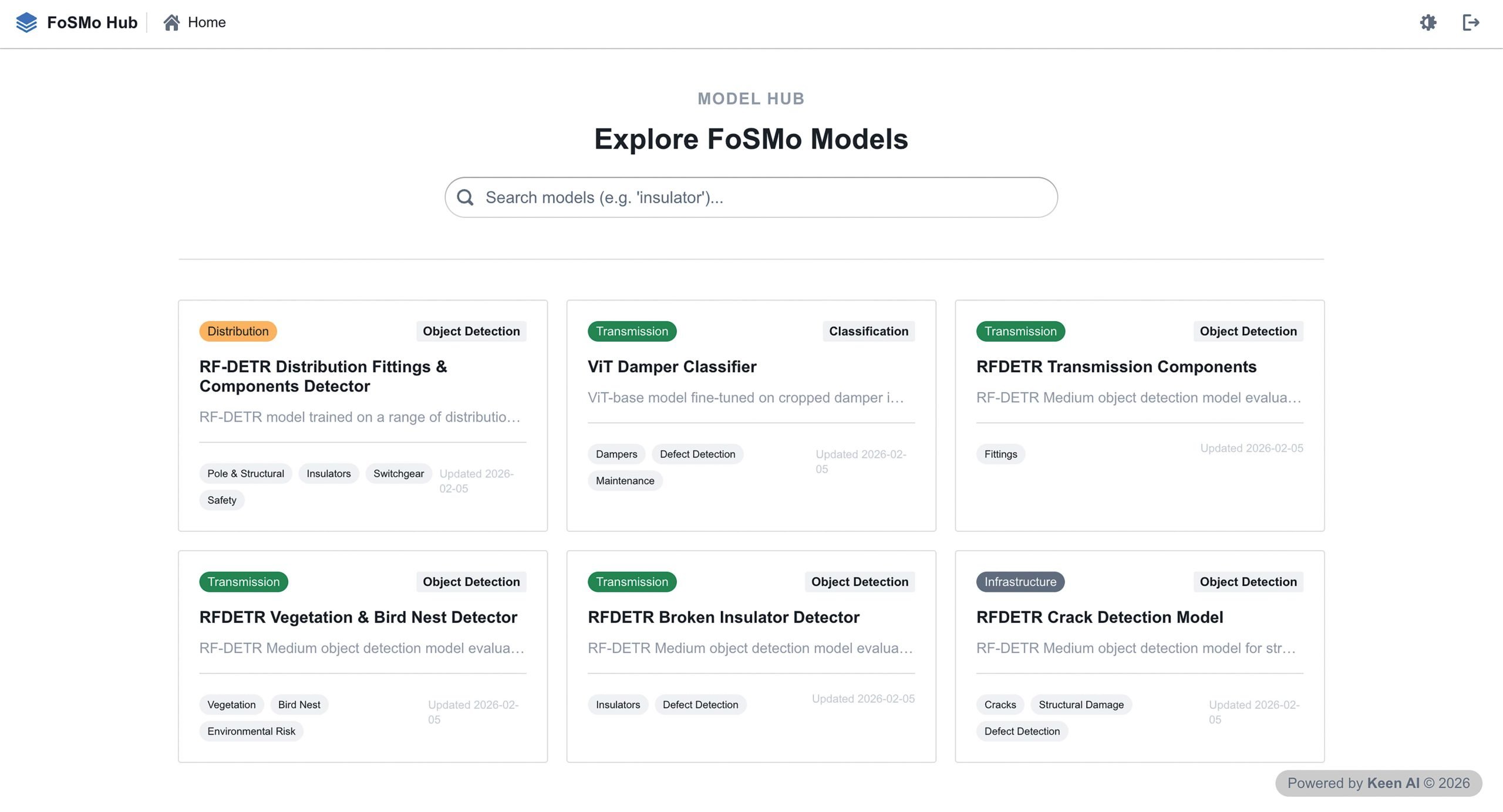
Led by Keen AI and funded by Ofgem’s SIF Discovery, FoSMo will create high-quality, centrally developed, continuously updated CV foundational models for the UK’s transmission and distribution networks.
All operators can benefit from shared computer vision (CV) models
The CV models will combine anonymised datasets from across the UK. NGET is participating, and we are seeking additional operators. FoSMo models will:
- Be permissively licensed for internal use by participating
operators at no further cost - Improve continuously as operators contribute new data
- Provide high-quality bases for operators to fine-tune to their networks
By providing shared computer vision (CV) models, FoSMo eliminates duplicated effort across the nine UK operators.
Avoiding each operator independently building approximately three similar models at around £0.7 million each is estimated to save the sector around £19 million. This is a conservative estimate, as most operators are attempting to develop more than three models.
By sharing anonymised datasets, operators can train models on rare defects that would otherwise occur too infrequently on a single network. This improves defect detection accuracy, supports more effective asset risk prioritisation, and strengthens long-term asset planning, ultimately reducing operational costs and resource demands.
Current CV use cases in Asset Management
Through a collaborative process, we will identify high-priority, shared use cases to guide the initial roadmap and ensure FoSMo models are valuable for both Transmission and Distribution networks.
These examples illustrate the tasks FoSMo models could support:
Defect & Anomaly Detection
Condition Assessment
Asset & Fittings Identification
Vegetation Management
Immediate and measurable early-use examples include:
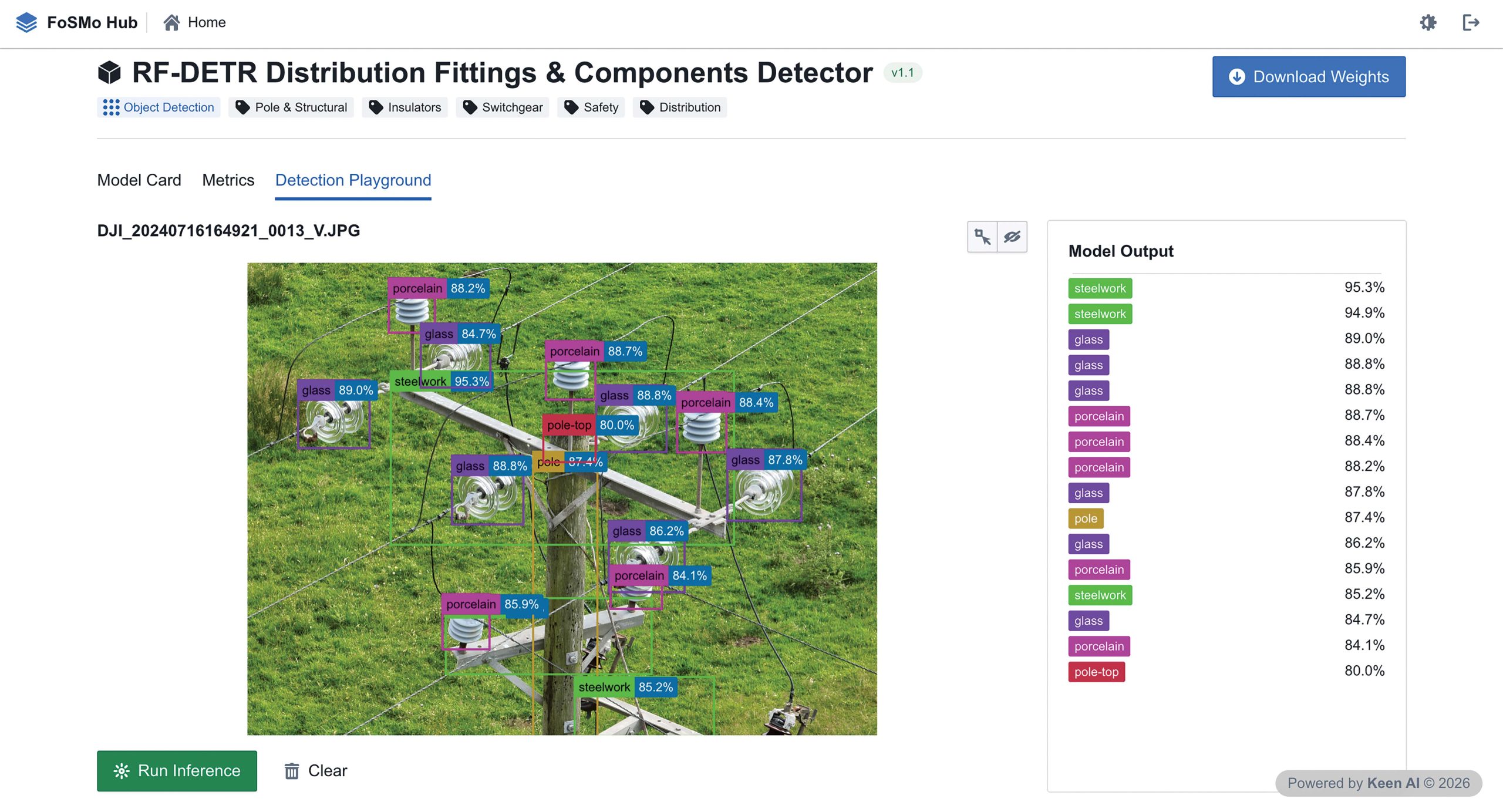
- Insulator Fitting Wear (U-bolts): Measures wear in insulator fittings, allowing proactive maintenance.
- Distribution Pole “Top Rot”: Detects top rot on poles and identifies defects on overhead line (OHL) fittings, supporting safer and more efficient network management.
- Component Detection: Recognises and categorises common network components, providing a consistent view of asset inventories.
These assets are common across operators, relevant data already exists, and outputs directly inform asset health and risk decisions: saving time and reducing operational effort from the start. Access to the first usable model weights or API is effectively immediate.
Furthermore, by integrating model use into an operator’s digitalisation strategy, standardised image capture can be enforced both internally and with suppliers. Knowing that images will feed directly into FoSMo models ensures higher-quality data, accelerates model improvement, and simplifies vendor instructions, strengthening both operational efficiency and data-driven decision-making.
Operators receive robust base models that can be fine-tuned internally, enabling tailored deployment without long-term dependence on proprietary third-party vendors. This flexibility accelerates implementation and reduces ongoing licence and support costs.
Technical & operational benefits
- More robust models and broader defect coverage through diverse datasets
- Increase operational independence by avoiding reliance on proprietary solutions
- Reduce unnecessary development work, freeing operator resources for higher-value innovation
- Faster response to emerging risks
Strategic & industry benefits
- Aligns with regulatory standards (RIIO T3, ED3, CNAIM,
and future Ofgem requirements) - Supports Net Zero expansion with standardised data
capture requirements for image and data collection - Accelerates AI adoption and innovation across the sector
- Saves ~£22.6 million* across the industry if all operators adopt core FoSMo models to improve network reliability.
* See full application for a detailed cost breakdown, including core adoption and customer interruption savings.
Flexible deployment paths for operators
Internal System
FoSMo Self-Hosted
Internal System
FoSMo API
FoSMo App
- Operator
- Inside Operator
- Outside Operator
Operator engagement for SIF Alpha Phase
FoSMo’s SIF Discovery phase confirmed that a shared-model approach is practical. Alpha will deliver model development, integration pilots, and roadmap planning.
Multiple operators have signed on for Alpha, recognising that broader participation will make the models robust, trusted, and industry-wide applicable, and will help shape their development.
Alpha Partner
NGET
SPEN-T
SPEN-D
SSEN-T
UKPN
SP ENW
Alpha Supporter
NGED
NPG
Pending
SSEN-D
Understanding operator benefits and commitments
Alpha will deliver model development, integration pilots and roadmap planning.
Model Development: Keen AI will lead the actual development of the models, while participating operators provide the training data and guidance. Participating operators contribute insights on which models are most needed, what data is realistically available, and ensure the models are trained on relevant, high-quality datasets. This collaborative approach ensures the resulting models are both practical and immediately useful.
Integration Planning: Participating operators’ IS, Digital, and Data Science teams work with the FoSMo Team to discuss how local deployment, backend REST APIs or a FoSMo application could be integrated with operator internal systems and workflows. This includes connecting model outputs to tools such as Maximo or Power BI. Asset managers then use the outputs directly in their workflow, reducing reliance on manual engineer assessments and accelerating operational adoption.
Roadmap Planning: Asset managers, data scientists, and other stakeholders participate in roundtables to prioritise which defect classes should be developed next. They also explore sustainable funding and deployment strategies for phases beyond the Alpha, ensuring that model development aligns with long-term operational needs and value delivery.
FAQ / Operator questions, answered
Could you clarify the expected level of commitment required from an operator?
The stated commitment of one to three days per month primarily reflects the time required from UKPN’s Innovation team, which coordinates and supports engagement across the business. In addition, other teams may be involved as follows:
- IT/Data Teams: Ensure secure data transfers (SFTP or physical media) and oversee data governance and stewardship.
- Digital & Data Science Teams: Provide guidance on model structure and integration, and support embedding model outputs into business systems.
These contributions are typically intermittent and advisory, supporting the Alpha phase without requiring full-time commitment.
How much influence do operators have in shaping the models and prioritising use cases, and at what point in the Alpha or Beta phases would this input begin?
All participating operators have an equal say in developing models and prioritising use cases. The aim is to ensure the outputs are maximally useful and technically effective for the whole sector.
Several operators provided input during the
Discovery phase, and all were involved in initial discussions. This engagement will continue throughout the six-month Alpha phase.
Participation includes industry forums, technical workshops, and roadmap planning sessions. Operators are actively encouraged to:
- Share their digitalisation strategies and highlight where FoSMo can align with them.
- Propose priority use cases for model development.
- Shape the foundational models by determining which defect classes and asset types should be addressed first.
This collaborative approach ensures that operators can directly influence the models and their deployment from the earliest stages.
How is use case prioritisation decided such as voting, steering group input, or a shared agreement among operators?
Use case prioritisation is decided through a collaborative agreement among operators, rather than simple voting. Decisions take into account what operators are most interested in solving, how widely the issue is shared across the sector, the availability and quality of relevant data, and clarity on who will collect it. The potential value to stakeholders, including operators, Ofgem, and consumers, is also considered.
These decisions are supported by governance mechanisms such as industry roundtables, longer-term steering groups which will guide priorities, drive data collection strategies, determine data contributions, and ensure the models remain aligned with real-world asset challenges.